
Voice to Quote in Australia: Calls Into Quotes
Picture this. A customer rings on a Wednesday arvo about a job — a fence that's seen better days, a hot water system on its last legs, a switchboard that's "doing something weird." You're up a ladder or under a house, so you can't talk properly, but you grab the details and promise to get a quote across "by the weekend."
Then the week happens. By Saturday you've done six jobs, fielded forty calls, and that quote is still a few scribbled notes on the back of a docket in the ute. You finally send it Sunday night. By then the customer's had two other quotes, picked one on Friday, and your effort goes straight in the bin.
That's the quoting problem in one ute-shaped nutshell. And it's expensive: Australian tradies consistently report losing five to ten hours a week to quoting, invoicing and paperwork. At a rough $120 an hour, that's $600 to $1,200 a week you're not billing. Worse, a same-day quote used to make you look sharp — now it's just the baseline. Customers compare two or three tradies at once, and the one who gets a clear quote back fastest usually wins, even when they're not the cheapest.
The frustrating part? The quote was never the hard bit. The hard bit is that the whole job lived inside a phone call that nobody had time to act on. Which is exactly the problem "voice to quote" is built to solve. Here's what it actually means in Australia, the two flavours of it, and why — surprise — the Australian phone call is the genuinely tricky part.
What "voice to quote" actually means
"Voice to quote" is a catch-all for using speech, rather than a keyboard, to produce a quote. Instead of sitting down at a screen and typing line items, the words become the quote. But it comes in two quite different forms, and it's worth being clear about which is which, because they solve different problems.
Tradie-dictated: you talk, the quote builds itself
The first form puts the tradie in the driver's seat. You're standing in the customer's backyard, you pull out your phone, and you talk: "Add eight fence bays, two gates, supply and install, plus a day's labour." The app turns that into structured line items, pulls in pricing, and hands you a tidy draft to tweak and send. A handful of Australian quoting apps now do a version of this, often paired with live supplier pricing so your numbers reflect what materials actually cost this week.
It's genuinely useful — it beats typing line items on a tiny screen with dirty hands. But notice the catch: you still have to stop, pull out the phone, and do it. It compresses the quoting job from ten minutes to one. It doesn't remove the job.
Call-to-quote: the customer's call becomes the quote
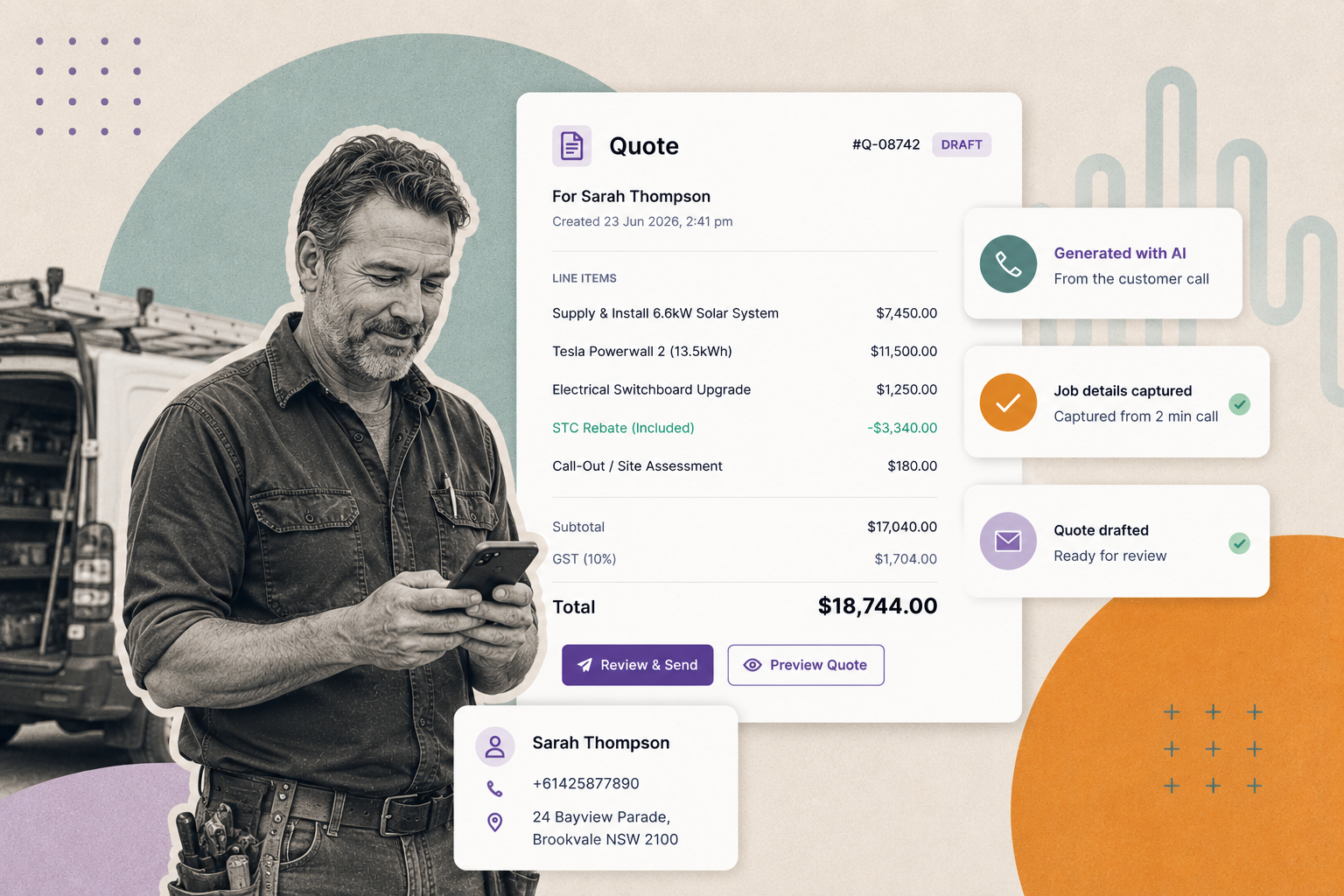
The second form is the more interesting one, and it's where the real lost time lives. Here, the customer's inbound call is the input. They ring, describe the job, and the AI that answers the phone doesn't just take a message — it understands the job, drafts a quote against your pricing, and drops it into a queue for you to review. You open your phone between jobs, glance at the draft, tweak if needed, and tap send. The quote goes out by SMS with a link the customer can tap to accept.
"The AI that answers the phone doesn't just take a message — it understands the job, drafts a quote against your pricing, and drops it into a queue for you to review."
The difference is profound. Tradie-dictation makes you faster. Call-to-quote means the quote is half-written before you've even heard about the job — generated from the conversation the customer was already having. The enquiry and the quote stop being two separate tasks separated by a week of good intentions.
Most of this article is about that second form, because that's where the Sunday-night-quote problem actually disappears.
Why the phone call is the hard part (not the quote)
Here's the bit the slick demos skip: to turn a call into a quote, the system first has to understand the call. And understanding an Australian on the phone is a genuinely hard engineering problem — hard enough that we wrote a whole separate piece on it. (Short version: most voice AI was trained on American English and measurably struggles with Australian accents, slang and the relaxed way we actually talk. If you want the deep dive on accents, "yeah-nah," and why imported tools fumble it, read our companion piece on how to understand an Australian caller.)
Generating the PDF at the end is the easy part. The hard part is upstream: a customer in a Broad regional accent, talking fast over a dodgy mobile connection from a moving car, describing a job in plain Aussie — "the gutter's chockers, there's a downpipe hangin' off the side, and the whole lot needs doing before the rain hits." A system that's going to quote from that has to:
- Hear it accurately — across the full range of Australian and multicultural accents, not just the newsreader voice.
- Understand the job — translate "the gutter's chockers and a downpipe's hanging off" into a service, a scope, and rough quantities.
- Know what it doesn't know — and ask the one clarifying question a good tradie would, rather than guessing.
If the understanding is wrong, the quote is wrong, and a wrong quote is worse than no quote. Which brings us to the single most important design principle in this whole category.
The non-negotiable: a human approves before anything is sent
A quote is a number with your name on it. Send a wrong one and you've either underquoted yourself into a loss or scared off a good customer. So any voice-to-quote worth trusting keeps a tradie in the loop: the AI does the heavy lifting — listening, drafting, pricing — and you approve before it goes anywhere.
This isn't a limitation; it's the entire point. The goal isn't "AI fires off quotes while you sleep." The goal is "the quote is 90% written and waiting for your thumbs-up the moment you next pick up your phone." You stay in control of the number. The machine just does the typing, the listening, and the remembering — the parts that were stealing your Sunday nights.
Be wary of anything that promises fully autonomous, no-human quoting. That's not confidence; that's a liability.
What call-to-quote looks like end to end
Here's how a call-to-quote flow works in practice, start to finish:
- The call comes in. A customer rings your usual number — answered on the first ring, day or night.
- The AI understands the job. It captures who's calling, where, what's wrong, and how urgent — in a natural conversation, not a robotic form.
- It drafts a quote against your pricing. It matches the job to your service catalogue and your rates — not generic guesses pulled from thin air.
- It lands in your queue. A draft quote, ready for you to review whenever you next look at your phone.
- You approve. Tweak the number if you want, then tap send.
- The customer gets it by SMS with a link they can tap to accept — no PDF buried in an email they'll never open.
- It flows into your system. Accepted jobs drop into the tools you already run, so there's no double-entry.
The whole loop turns a Wednesday-arvo phone call into a sent, trackable quote — often before you've climbed down off the ladder.
What it sounds like
Here's an illustration of how a call-to-quote conversation plays out, in the kind of plain Aussie a real customer actually uses:
AI: "Hi, you've reached Coastline Gutters. How can I help?"
Customer: "Hi — my gutters are completely blocked and a downpipe has come away from the wall out the back. It's a single-storey brick place. I was hoping to get it sorted before the rain this weekend."
AI: "No problem. So that's a full gutter clean plus refitting a downpipe on a single-storey brick home — is that right?"
Customer: "Yes, that's it."
AI: "Great. What's the address, and what's the best number to text the quote to?"
From that ninety-second chat, a call-to-quote system can draft a quote — gutter clean, downpipe refit, single-storey — priced against the business's own rates, and pop it in the owner's queue. They review it over a coffee, adjust if needed, and send. The customer gets a text with a one-tap accept link while they're still thinking about it. No back-of-the-docket notes. No Sunday night.
How this fits with the tools you already use
If you're running ServiceM8, Simpro, Fergus, AroFlo or similar, you've already got quoting features — templates, job cards, online acceptance, the lot. Voice to quote isn't a replacement for those; it's the missing front end. Those tools are brilliant once a quote exists. The gap they don't close is the one between the live phone enquiry and that quote existing in the first place. That handover — from "a customer just called" to "a draft quote is ready" — is precisely what a call-to-quote layer is for, feeding straight into the system you already run rather than asking you to switch.
What to look for in a voice-to-quote tool in Australia
If you're weighing up options — now, or as more of them launch — here's the checklist that separates the real thing from the brochure:
- It understands real Australian callers. Accents, slang, the relaxed phone register — not just an "Australian voice" setting on the output. Test it with a fast, Broad-accented description and a "yeah-nah."
- A human approves before anything sends. Your name, your number, your call.
- It quotes against your pricing. Your catalogue and rates, not generic estimates.
- It delivers by SMS with one-tap acceptance. Not a "Do Not Reply" PDF the customer ignores.
- It flows into your existing system (ServiceM8, Simpro, Fergus, AroFlo) with no double-entry.
- It's built and run in Australia — for local pricing, data residency, and AU calling compliance.
How Chime thinks about quoting
The way we see it, a quote shouldn't be a separate job you do later — it should fall out of the conversation the customer already had with you. The call is where the job gets described, in the customer's own words. That's where the quote should start. And a tradie should always have the final say before a number with their name on it goes anywhere.
So everything starts with the call. Chime answers every one in a natural Australian voice, understands the caller — accent, slang and all — qualifies the job, and books it, so the details land cleanly instead of getting scrawled on the back of a docket. Get that part right, and turning the conversation into a quote stops being a leap and starts being the obvious next step. If you want the product page on this directly, see Voice to Quote — or, if you'd rather start from the dictation/typed angle, our AI quote generator for tradies.
FAQ
Can AI really create a quote from a phone call?
Yes — the technology can listen to an inbound call, understand the job being described, and draft a quote against your pricing for you to review. The genuinely hard part isn't producing the document; it's accurately understanding an Australian caller — accent, slang and all — well enough that the resulting quote is right. A quote built on a misheard call is worse than no quote, which is why understanding the conversation is the foundation everything else sits on.
What's the difference between voice to quote and an AI receptionist?
An AI receptionist answers your calls, qualifies the job and books it. Voice to quote takes the next step: it turns the details from that call (or from a tradie's spoken description) into a draft quote. They're complementary — the receptionist captures the conversation, and voice to quote turns that conversation into a priced quote you can send.
Does a human check the quote before it's sent?
With any trustworthy system, yes. The AI drafts the quote; the tradie reviews and approves it before it goes to the customer. You stay in control of the number. Be cautious of anything that claims to send quotes fully autonomously — that's a fast way to underquote a job or lose a good customer.
What's the difference between tradie-dictated and call-to-quote?
Tradie-dictated means you speak the quote — "add eight fence bays and two gates" — and the app builds the line items. Call-to-quote means the customer's inbound call is turned into a draft quote automatically, so it's half-written before you've even picked up the phone. The first makes you faster; the second removes the task almost entirely.
Will it work with ServiceM8, Simpro or Fergus?
The right approach plugs into the job-management software you already use rather than replacing it, so accepted quotes and jobs flow through without double-entry. When evaluating any tool, check that it integrates with your specific system.
Is voice to quote built for Australian accents and pricing?
This is the question that matters most. A lot of voice AI is trained on American English and struggles with Australian accents and slang. For quoting specifically, the tool also needs to use your real Australian pricing, handle GST correctly, and deliver in a way local customers actually respond to. Always test it with a real, fast, Australian-accented call before you trust it with a number that has your name on it.
The bottom line
The quote was never the hard part. The hard part is that your jobs start as phone calls — fast, accented, slang-filled Australian phone calls — and too many of those calls turn into notes on a docket that become a quote three days too late.
Voice to quote closes that gap: the conversation becomes the quote, you approve it, and it's in the customer's hands while they're still deciding. Tradie-dictated quoting makes you quicker on site; call-to-quote means the quote's half-done before you've heard about the job. Either way, the win is the same — fewer Sunday nights, more jobs won, and the fastest clear quote in a customer's inbox.
It all starts with the call. Chime answers every one in a natural Australian voice, understands the caller, captures the job, and books it — so the conversation a quote should come from never slips to voicemail in the first place. See how Chime works. We reckon you'll like what you hear.
Never miss the call a quote should come from
Chime answers every call in a natural Australian voice, understands the caller, captures the job and books it — 24/7.