
The Quote Is the Most Under-Managed Number in Australian Trades
If you asked a hundred trades business owners what their most important commercial metric is, you'd hear leads, revenue, job size, maybe gross margin. You'd almost never hear quote-to-job win rate.
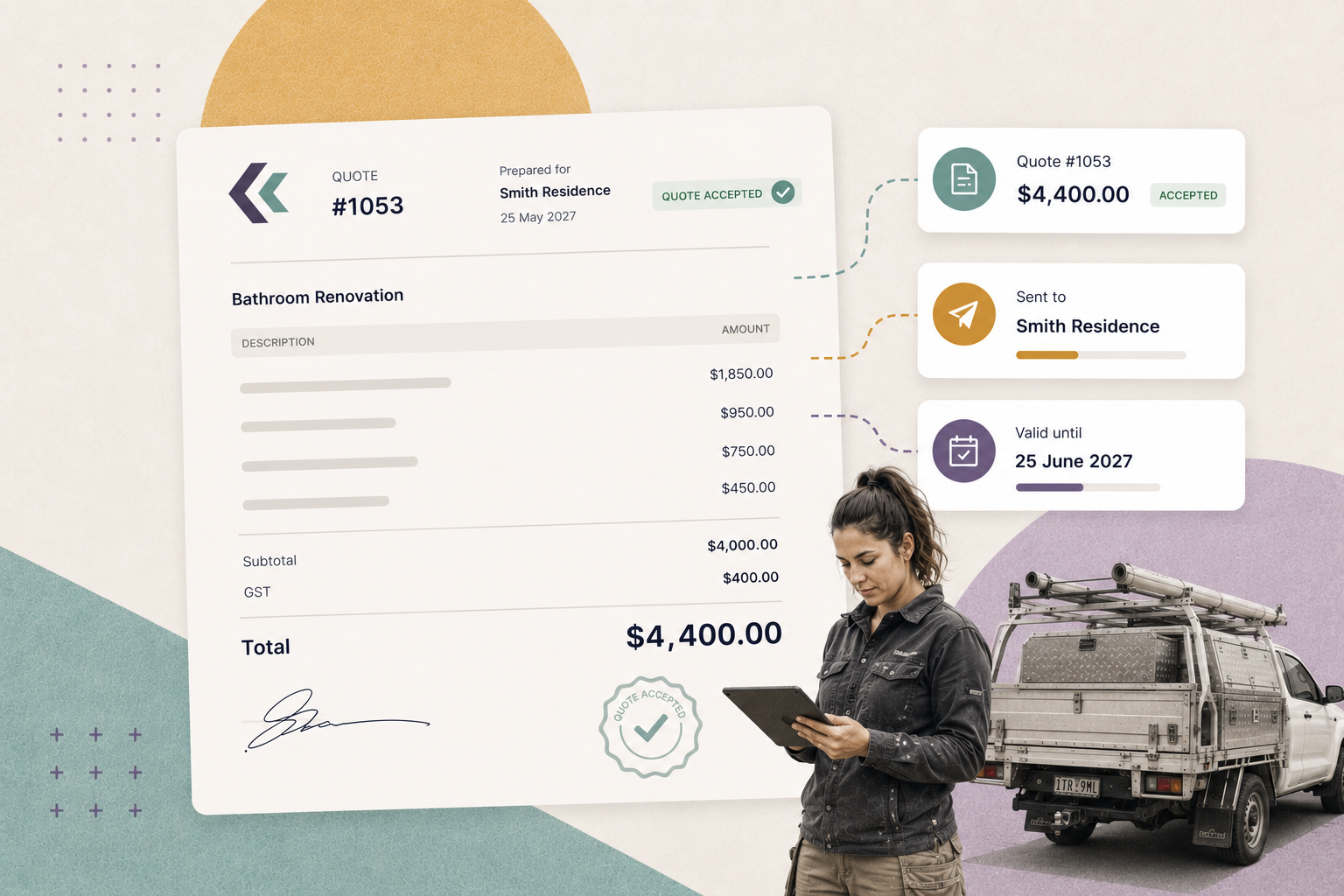
That's a problem. Because the quote is where lead spend turns into revenue — or quietly evaporates.
The number nobody's looking at
Across the trades operators we work with — plumbers, sparkies, HVAC techs, gutter cleaners, locksmiths, pest controllers — we see enormous variance in how often quotes turn into paid jobs. Some businesses convert close to two-thirds of the quotes they send. Others, doing similar work in similar markets, struggle to close one in three.
The gap usually isn't pricing. It isn't lead quality. It's what happens between the enquiry and the yes.
Translate the variance into dollars. Two trades businesses, same lead flow, same average job value. One sits at 32%, the other at 48%. The 48% business books 50% more revenue from the same marketing spend. No new leads. No new website. No price changes. Just a better quoting motion.
That's the most leveraged number in the business. And most operators have no idea what theirs is.
Quoting isn't admin
The biggest mistake we see — and we talk to a lot of trades owners — is treating quoting as paperwork. Something you do after the customer call. In the evenings. Between jobs. When you remember to.
It's not paperwork. It's the conversion stage of your sales funnel.
The phone rings. That's lead generation. The quote goes out. That's conversion. The job runs. That's delivery. Every other industry obsesses over the middle step. Trades treats it like an afterthought.
The cost of that is hidden because it's a non-event. A quote that never gets sent doesn't show up in your books. A customer who never followed up doesn't appear in your CRM. You can't see what you lost — you only see what you won.
Where the losses actually live
When we dig into the quoting stage with operators, four leaks come up over and over.
Speed
Customers who request a quote are usually approaching two or three other tradies the same day. The first responder usually wins, and not because they're cheapest — because they're there. The average response time we see across residential trades in Australia is measured in days, not hours. By then the job is gone.
Misread intent
Phone enquiries get logged inconsistently. A customer ringing for a quote gets booked as a job. A customer ready to book gets sent away with a quote. The signal is in the call — quote vs. confirmed work vs. urgent — and most trades businesses have no reliable way to capture it. The intent gets reconstructed from memory at 8pm.
No follow-up
Quote goes out. Silence. Most trades businesses don't have a structured follow-up beyond, at best, a maybe-text two or three weeks later. The data on this is consistent across every industry that's measured it: a single well-timed follow-up can lift win rate by double digits. Trades are leaving that on the table.
Quotes that don't sell
A quote is the only piece of writing a tradie sends a customer that has to win something. Most quotes are a price, a line item, and a PDF. They don't show options. They don't explain trade-offs. They don't make it easy to say yes. Compare that to how a homeowner buys anything else of similar value — a car, a holiday, a renovation — and the gap is obvious.
Why this matters right now
Three things are converging.
Customers are scrutinising quotes more than ever. The RBA cash rate sits at 4.35% after three hikes this year. Households are getting three quotes, not one. The bar for what a winning quote looks like has moved, and the tradie who sends the clearest, fastest, most considered quote is materially advantaged.
The supply side is constrained. Labour market data points to a shortfall of tens of thousands of qualified tradespeople across Australia, and the gap is widening as the workforce ages. The operators who win the next decade aren't the ones doing more jobs — they're the ones winning a higher percentage of the quotes they already have in front of them. You can't out-hustle a labour shortage. You can out-convert one.
The tooling is catching up. AI is now capable of capturing call context, structuring quote intent, and drafting estimates with enough fidelity that the gap between "what the customer asked for" and "what got quoted" is closing. The conversion stage is becoming measurable in a way it hasn't been before. That changes the operating ceiling for the businesses that adopt early.
What we're paying attention to at Chime
We've spent the last several months talking to plumbers, sparkies, HVAC techs, gutter cleaners, locksmiths, pest controllers — anyone who'll have us — about how they quote, why they win, why they lose, and where the time goes.
The patterns are consistent. Quoting takes longer than anyone admits. Win rates aren't tracked. Follow-up is ad hoc. And the gap between a quick, structured, mobile-friendly quote and a wall-of-text PDF is enormous in terms of whether the customer says yes.
We're not announcing anything yet. But quoting is a problem worth solving properly, and we think the businesses that get it right over the next twelve months are going to be measurably ahead of the ones that don't. More soon — in the meantime, the early shape of what we're building is on the Voice to Quote and AI Quote Generator for Tradies pages.
Curious where your quoting stands?
See how Chime Labs is rethinking the quoting stage for Australian trades — from call to sent quote, without the after-hours admin.