
AI Receptionist Australia: Why the Aussie Accent Is the Hard Part (and How to Get It Right)
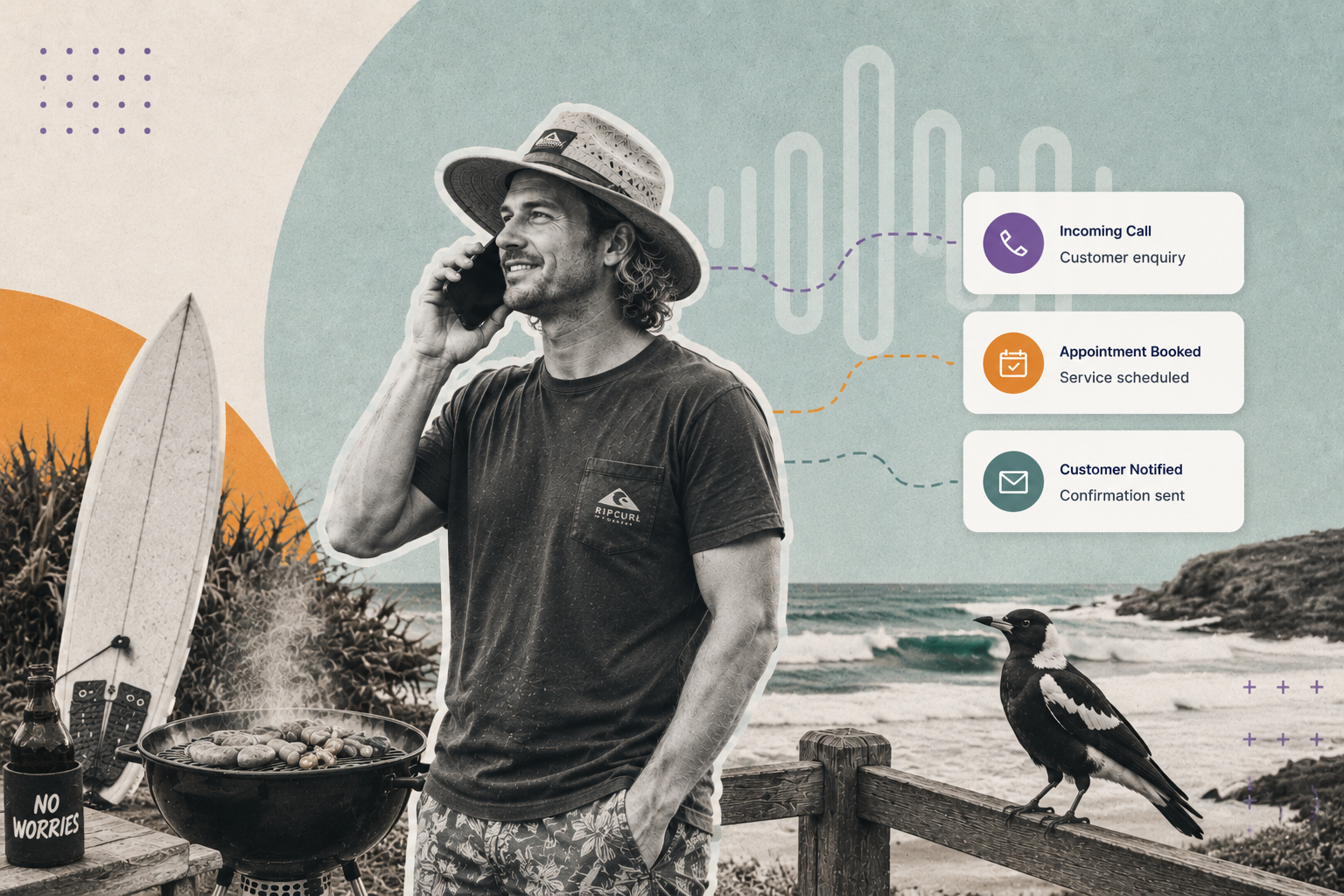
Picture this. It's 7:14 on a Tuesday night. A bloke in a Broad Queensland accent rings a plumber about a hot water system that's "carked it." He talks fast, he drops his vowels, and halfway through he says the laundry's "chockers" with water and he needs someone "this arvo, or tomorra at the latest, no dramas if it's a bit of a wait."
A good Australian receptionist hears all of that and books the job in ninety seconds.
A cheap AI receptionist — the kind that was trained almost entirely on American English and dressed up with a flag emoji — hears "my water system has what?", asks him to repeat himself twice, mishears "arvo" as a name, and then cheerfully offers to book him for "this afternoon or tomorrow." Which is the right answer, technically. But by the time it's fumbled its way there, the customer has already hung up and rung the next plumber on Google.
That gap — between an AI that speaks Australian and one that just says it does — is the whole story of this article. If you're shopping for an AI receptionist in Australia, the accent and the slang aren't a nice-to-have. They're the entire ballgame. Here's why, and here's how to tell the real thing from the tourist.
First, why this even matters: the missed-call problem is an Australian problem
Let's get the business case out of the way, because it's the reason any of this is worth caring about.
Australian service businesses live and die on the phone. Tradies, clinics, salons, removalists, mobile mechanics — the job almost always starts with a call. And a huge share of those calls go unanswered, because the person who'd answer them is up a ladder, under a sink, mid-treatment, or driving between sites. Industry estimates and our own customer data point to the same uncomfortable truth: a typical trades business misses a big chunk of its inbound calls, and after-hours and weekends are worse. Every one of those is a customer who, more often than not, simply dials the next name on the list.
So the pitch for an AI receptionist is simple and genuinely compelling: answer every call, on the first ring, 24/7, and turn missed calls into booked jobs. No voicemail. No "leave a message and we'll get back to you" (we won't, and the customer knows it).
But here's the catch nobody puts on the homepage. An AI receptionist only captures that job if the caller feels understood. And feeling understood, in Australia, is a much harder engineering problem than the glossy marketing suggests. Because we don't talk like the training data.
The uncomfortable truth: most voice AI was raised on American English
Almost all of the foundational speech technology that powers today's voice AI — the speech-to-text models, the voices, the benchmarks — was built and tuned first and foremost on American English. That's not a conspiracy; it's just where the biggest datasets and the biggest market were.
The result is a measurable accent gap, and it's well documented. Research out of the University of Cambridge evaluating OpenAI's Whisper model (one of the most widely used speech-recognition models in the world) found it transcribed American English noticeably more accurately than British or Australian English — despite all three being native varieties of the same language. Independent 2025 benchmarks of various speech-to-text services told a similar story: error rates on accented speech ran far higher than on standard American audio, with some mainstream cloud models posting word-error rates north of 30% on accented speakers. For context, a word-error rate that high means roughly one word in three is getting mangled. That's not a receptionist. That's a bad phone line.
We've all lived this. Anyone who's owned an early Siri or Alexa remembers the ritual of slowly. enunciating. like. a. robot. just to get the thing to set a timer. Scottish and Irish users had it even worse, to the point that people genuinely changed how they spoke to be understood by a machine. There's even a serious linguistics concern that voice tech could, over time, flatten regional accents because people adapt their speech to suit the technology rather than the other way around.
Now apply that to a plumber's after-hours line in Toowoomba. If the technology was built for a Californian and the caller is a fourth-generation Queenslander with a Broad accent and a burst pipe, the maths doesn't work. The model isn't "a bit off." It's operating outside the world it was trained on.
This is the single most important thing to understand about an AI receptionist in Australia: the hard part was never answering the phone. The hard part is understanding the person on the other end.
There is no such thing as "the Australian accent"
Here's where it gets properly interesting — and where most providers quietly give up.
When a vendor says their AI handles "the Australian accent," they're imagining one accent: the friendly, mid-strength voice you hear reading the news. Linguists call that General Australian, and it's roughly what most people picture. But it's only one of three traditional varieties, and the country is far more diverse than even that suggests.
- Broad Australian — the strong, unmistakable accent. Think a stockman, a tradie from the regions, the classic "throw another snag on the barbie" voice (which, for the record, no one actually says — more on that later). Heavily reduced vowels, dropped consonants, fast delivery.
- General Australian — the most common, middle-of-the-road accent. Most of your callers.
- Cultivated Australian — closer to received British pronunciation. Less common now, but still out there.
And that's just the traditional model. Modern Australia is one of the most multicultural countries on earth, which means the phone rings with Multicultural Australian English in all its forms — Lebanese-Australian, Vietnamese-Australian, Greek-Australian, Italian-Australian, Indian-Australian, and dozens more, each with its own rhythm and vowel set. There's Aboriginal English, with its own grammar and intonation, spoken across remote and urban communities. There are migrants speaking English as a second or third language. And there are genuine regional differences too — the way "castle" or "dance" gets said shifts as you move from Adelaide to Brisbane, and there's a long-running, only-half-joking war over whether the swimmers/togs/cossie/bathers debate marks which state you grew up in.
So when someone promises "the Australian accent," the honest follow-up question is: which one? A receptionist that nails General Australian but face-plants on a Broad regional accent or a strong second-language accent isn't an Australian receptionist. It's an American receptionist that learned one Australian impression for the demo.
A receptionist worth paying for has to understand the caller it actually gets — not the caller the marketing team imagined.
Then there's the slang, which is its own minefield
If the accents are the melody, the slang is the lyrics — and we've written a lot of them.
Australian English is gloriously, aggressively informal, and it leaks straight into phone calls. A real caller doesn't say "I would like to schedule an appointment for the afternoon." A real caller says "Yeah gday, can someone swing past this arvo? Place is a bit of a state." An AI receptionist that doesn't understand the second sentence is going to have a rough night.
Here's a small sample of what an Australian AI receptionist has to take completely in its stride — no hesitation, no "I'm sorry, could you repeat that":
- arvo — afternoon ("can ya come this arvo?")
- servo — service station / petrol station
- sparkie — electrician. (A chippie is a carpenter, a brickie lays bricks, a plumber's still just a plumber, and a truckie drives the truck.)
- reno — renovation
- chockers / chockas — completely full ("the gutter's chockers")
- heaps — a lot ("there's heaps of water coming through")
- flat out — extremely busy ("I'm flat out 'til Thursday")
- dodgy — faulty or suspicious ("the wiring looks a bit dodgy")
- carked it / cactus — broken, dead ("the aircon's cactus")
- give us a bell / give us a buzz — call me back
- no dramas / no worries / she'll be right — it's fine, don't stress
- maccas, bottlo, garbo, rego, ambo, mozzie, sunnies, snag, esky — and a hundred more, because we shorten everything and then add an "o" or a "y" to it
And the genuinely tricky ones aren't the words — they're the constructions. The most famous is "yeah, nah" and "nah, yeah." To an Australian, "yeah, nah" means no (with a soft landing) and "nah, yeah" means yes (with a bit of consideration first). To a literal-minded machine, both are gibberish. A customer who says "yeah, nah, don't worry about today, tomorrow's better" has just rescheduled — and a bad AI just heard the word "yeah" and booked them for today anyway.
This is the bit that separates marketing from engineering. Anyone can record an Aussie voice actor and call it a day. Understanding "yeah-nah" in context, in a Broad accent, over a dodgy mobile connection from a moving ute — that's the actual work.
It's not just words. It's how Australians talk on the phone
Even if you understand every accent and every slang term, you can still get the register completely wrong — and Australians have a finely tuned radar for it.
We are, culturally, a country of understatement and informality. We're suspicious of anyone who's too polished, too eager, or too scripted. A receptionist that's relentlessly chipper — "Absolutely! I'd be thrilled to assist you with that today!" — reads as fake to an Australian ear in about four seconds. We don't want thrilled. We want competent and easy to deal with.
A few of the unwritten rules of an Australian phone call:
- Understatement is the default. A serious problem gets described as "a bit of an issue." A disaster is "not ideal." The receptionist has to recognise that "the bathroom's a bit wet" might mean there's two inches of water on the floor.
- Warmth without performance. "No worries" does more relationship work than a paragraph of corporate courtesy. Friendly, brief, unbothered. That's the tone.
- Get to the point. Australians appreciate efficiency and find over-explaining suspicious. The fastest way to lose a caller is to make them sit through a long automated greeting before they can say what they want.
- Don't oversell the Aussie-ness. This is the big one. There is nothing more embarrassing than an AI that's been told to "sound Australian" and now says "crikey" and "throw a shrimp on the barbie" (it's a prawn, and no one's saying it). Forced slang is worse than no slang. The goal is an AI that sounds like a normal local who happens to be good at their job — not a tourism ad that learned to answer phones.
That last point is the uncanny valley of Australian voice AI, and a surprising number of products fall straight into it. Authenticity here is mostly about restraint. The most "Australian" thing a receptionist can do is be relaxed, clear, and quietly competent — and then handle the slang when the caller uses it, without showing off.
And the dead giveaway: can it pronounce the address?
Want to know in one move whether an AI receptionist is genuinely built for Australia? Listen to how it reads back a suburb.
Australian place names are a beautiful trap, full of inherited British spellings, Indigenous names, and pronunciations that follow no rule a foreign model would guess:
- Launceston is "LON-ses-tun," not "Lawn-CES-ton."
- Prahran is "Pruh-RAN" (or just "Pran" if you're local), not "Prah-han."
- Canberra is "CAN-bruh," not "Can-BERR-ah."
- Cairns is basically "Cans."
- Woolloomooloo is exactly as fun to say as it looks, and an imported model will not even attempt it.
- Manuka in Canberra is "MAH-nuh-kuh" (and arguing about it is a local sport).
- Melbourne is "MEL-bn," not "Mel-BORN."
A receptionist that confidently mangles the caller's own suburb has just told them, loud and clear, that it isn't from around here — and that it's a machine. A receptionist that says the suburb the way the caller says it has done something subtle and powerful: it's disappeared. The caller stops thinking about the technology and just gets on with booking the job. That's the entire goal.
What a properly built Australian AI receptionist actually does
So what does it take to do this well? In plain language, without the jargon, here's what separates a genuine Australian AI receptionist from a rebadged overseas one:
- It's tuned to understand Australian speech, not just produce it. The understanding side (speech recognition) matters more than the talking side, because that's where the accent gap bites. A serious provider works specifically on recognising Australian accents — including Broad and multicultural ones — over real-world phone audio, which is compressed, noisy, and frequently coming from a mobile in a moving vehicle.
- It handles slang and Aussie constructions in context. Not a dictionary lookup of "arvo," but genuine comprehension of "yeah-nah," understatement, and the way real people actually phrase a request.
- It sounds local without trying too hard. A natural Australian voice, the right warm-but-brief register, and — crucially — the good sense not to perform. No "crikey." Ever.
- It's fast. Latency is part of accent comprehension, oddly enough. Australians read a long pause as the machine being confused, and a confused machine gets hung up on. The conversation has to flow.
- It pronounces the local stuff correctly — suburbs, street names, the difference between a sparkie and a chippie — because those are the tells.
- It knows when to tap out. The best receptionists, human or AI, know their limits. When a call gets genuinely complex — a tricky quote, a delicate complaint, an emergency that needs a human — it escalates cleanly to you with the full context, rather than bluffing.
- It plugs into the tools you already run. Capturing the call is only useful if the job lands somewhere. A good Australian AI receptionist books straight into the systems trades and service businesses actually use here — ServiceM8, Tradify, Simpro, Google Calendar — and sends you a clean summary, transcript and recording so nothing falls through the cracks. (We go deep on this in our guide to an AI receptionist for plumbers, and the same principles apply for electricians and every other trade.)
What it sounds like when it's done right
Here's the Tuesday-night burst pipe from the top of this article, handled by a receptionist that actually speaks Australian:
AI: "G'day, you've reached Mike's Plumbing. What can I do for ya?"
Caller: "Yeah gday — me hot water's carked it and the laundry's chockers. Need someone this arvo if ya can, or tomorra."
AI: "No worries, sounds like a bit of a mess. Is water still coming out, or has it stopped?"
Caller: "Nah it's stopped, just a heap on the floor now."
AI: "Righto. I can't get anyone there this arvo I'm afraid, but I've got a 7:30 first thing tomorrow morning. That suit?"
Caller: "Yeah nah that's perfect, cheers."
AI: "Beauty. Can I grab your name and the address?"
Caller: "Dave, 14 Prahran Place, Reservoir."
AI: "Got it Dave — 14 Prahran Place, Reservoir, 7:30 tomorrow. I'll flick you a text to confirm and Mike'll give you a buzz if he's running early. All good?"
Caller: "Too easy. Thanks mate."
Notice what happened. It understood "carked it," "chockers," and "this arvo." It correctly read "yeah nah that's perfect" as a yes. It didn't perform any slang it didn't need to. It said "Prahran" right. And it booked a job that the voicemail would have lost. That's an AI receptionist in Australia doing the one thing it's actually for.
How to choose one: the five-minute test
If you're comparing providers, ignore the homepage adjectives and run this test instead. Get on a demo call and:
- Use slang on purpose. Say "this arvo," "give us a bell," "the aircon's cactus." See if it keeps up or stalls.
- Throw a "yeah-nah" at it. Reschedule with "yeah nah, tomorrow's better." Did it understand you cancelled today?
- Make it say a hard suburb. Give it an address in Launceston, Prahran, or Canberra and listen to the read-back.
- Talk fast, like a real customer would. Not slowly and clearly. The way you'd actually talk with a burst pipe.
- Ask where it's built and trained. "Has a natural Australian voice" is about the output. Ask what it's trained to understand. That's where the real difference lives.
Anything that passes all five is genuinely built for here. Anything that needs you to talk like a newsreader is built for somewhere else.
FAQ
Can an AI receptionist actually understand the Australian accent?
A well-built one, yes — but it depends entirely on how it was trained. Most voice AI was developed first on American English and is measurably less accurate on Australian speech, so generic or imported tools often struggle with Broad and multicultural accents over real phone-line audio. An AI receptionist built and tuned specifically for Australia handles this far better, because understanding local speech was the design goal, not an afterthought.
Does an AI receptionist understand Australian slang like "arvo" and "yeah-nah"?
A quality Australian AI receptionist does. The easy part is recognising single words like "arvo" or "servo." The harder part is understanding constructions like "yeah, nah" (which means no) and "nah, yeah" (which means yes), plus the understatement Australians use on the phone. This is exactly where cheaper, overseas-trained tools fall down.
Will callers be able to tell it's an AI?
With the better systems, often not — at least not immediately. Many callers assume they're speaking to a new staff member, and some even ask to be put back through to "the person I was just speaking with." The giveaways are usually a forced or American accent, mispronounced local place names, awkward pauses, or slang that's laid on too thick.
Why do some AI receptionists sound so fake?
Two reasons. First, an accent or comprehension gap from being trained on overseas data. Second — and more avoidable — trying too hard to "sound Australian" by overusing slang like "crikey." Australians read over-performance as inauthentic. The best receptionists sound relaxed, brief and competent, and only use slang naturally when the caller does.
Does an AI receptionist replace my staff?
No — and the good ones don't try to. The strongest setup is an AI that handles the routine, repetitive calls and after-hours overflow brilliantly, captures the details, and escalates anything genuinely complex — a tricky quote, a complaint, an emergency — straight to a human with full context. It's there to make sure no call goes unanswered, not to pretend to be something it isn't.
What should an AI receptionist integrate with in Australia?
For trades and service businesses, the ones that matter most are ServiceM8, Tradify, Simpro and Google Calendar, so bookings land directly in the system you already run. It should also send you a summary, transcript and recording of every call so you've got a clear record and nothing slips through.
The bottom line
Answering the phone is the easy part. Any AI can pick up and say hello. The hard part — the part that decides whether you book the job or lose it — is understanding a real Australian, with a real Australian accent, using real Australian slang, in the relaxed, understated way we actually talk on the phone.
That's not a feature you can bolt on with a voice setting and a flag emoji. It has to be built in from the start, for here. Get it right and the technology disappears: the caller just feels like they reached someone who got it, and your business books a job it would otherwise have missed at 7:14 on a Tuesday night.
That's what we've built Chime to do — answer every call like a local who actually knows what they're doing. If you want to put it through the five-minute test above, see pricing or start free, and throw your worst "yeah-nah" at it.
We reckon it'll be right.
Ready to put it through the five-minute test?
Throw your worst "yeah-nah" at Chime and see how an AI receptionist built for Australia actually sounds.