
AI for Mechanics: How an AI Phone Receptionist Books Work While You're Under the Bonnet
Every workshop has the same problem, and it has nothing to do with cars. The phone rings while both hoists are up, your one front-of-house person is chasing a parts order, and the bloke calling about a logbook service gets three rings and voicemail. He doesn't leave a message. He calls the shop down the road instead.
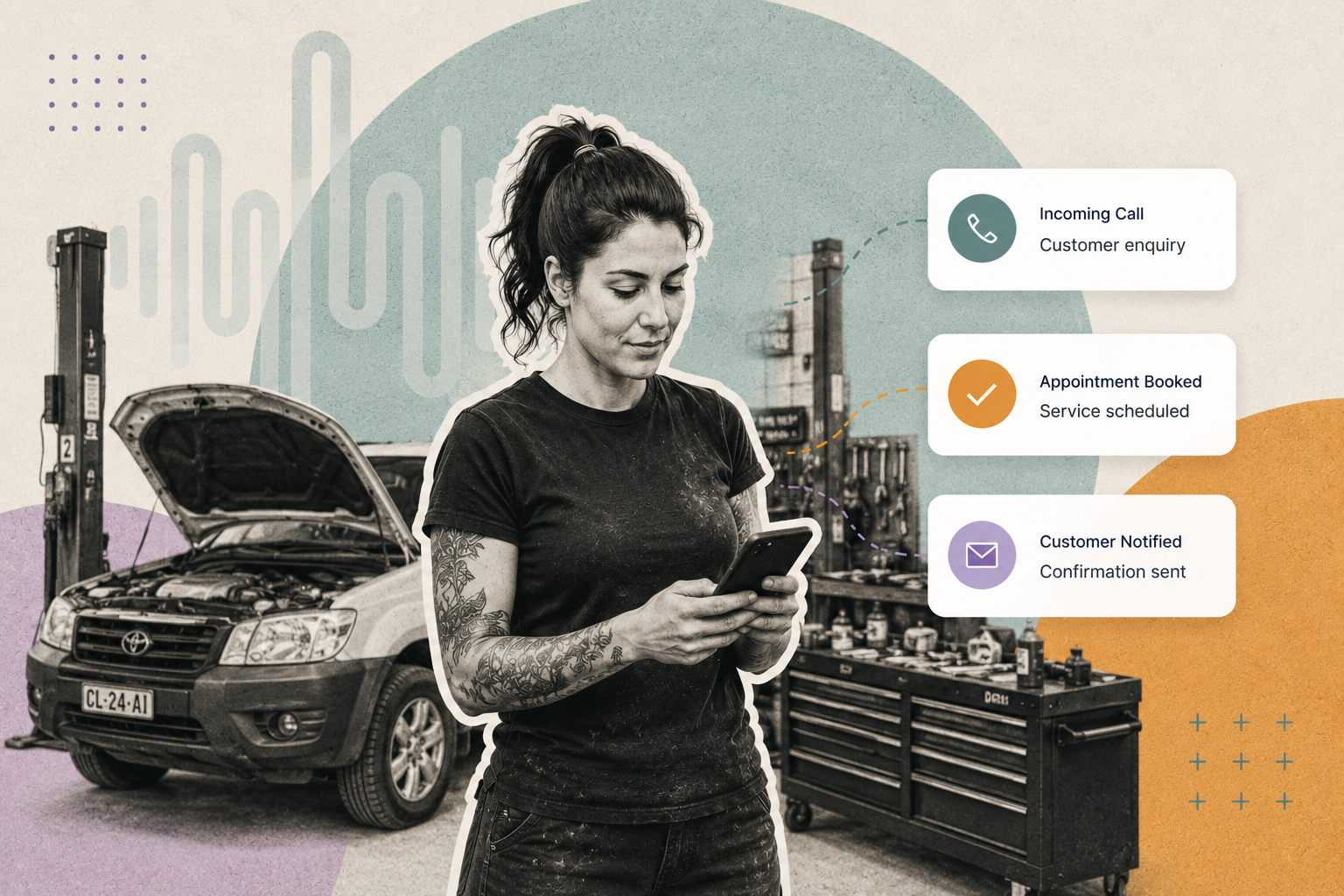
That missed call was a booked job. Multiply it across a busy week and the leak is real money — not from work you did badly, but from work you never heard about.
This is the gap "AI for mechanics" is starting to fill. Not robots turning spanners — an AI phone receptionist that answers every call, works out what the caller needs, and books it straight into your diary, so your team can stay on the tools.
What "AI for mechanics" actually means
Strip away the hype and it's narrow and practical. An automotive AI receptionist is a voice agent that picks up your inbound calls — first ring, every time, including after hours — and handles the conversations your front desk normally would:
- Answering the call professionally, in a natural voice, without hold music or a queue.
- Capturing the details that matter: vehicle make, model, year and rego; the customer's name and number; and a plain-English description of the problem.
- Booking the job into your calendar, against your actual availability.
- Triaging the urgent stuff (a car that won't start, a brake warning light) from the routine (a service due next month) and flagging it to you.
- Following up — a confirmation text, a reminder the day before, a callback task when a human needs to ring back.
It is not there to diagnose a gearbox over the phone or quote a rebuild sight unseen. It's there so that the eight calls you'd otherwise miss between 8am and 10am all get answered, qualified and booked — instead of going to the competition.
The real problem: the people who answer the phone are the same people fixing the cars
Most independent workshops don't have a dedicated receptionist. The phone gets answered by whoever is closest and least busy — which, on a good day, is nobody. So calls go unanswered, callers move on, and the only record you have of the job you lost is a missed-call notification you'll see at lunch.
Hiring a full-time front-of-house person solves it, but that's a serious annual cost for a small shop, and they still go home at 5pm and take holidays. An after-hours answering service takes a message, but a message isn't a booking — and a customer with a flat battery on a Sunday wants an appointment, not a promise that someone will ring back Monday.
An AI answering service for an auto repair shop sits in between: cheaper than a hire, available 24/7, and — unlike a generic message-taking service — actually able to book the job while the customer is still on the line.
The part most articles skip: the booking logic
Here's where a system built for a workshop earns its keep, and where most "AI receptionist" pitches go quiet. Answering the phone is easy. Booking the right job, in the right slot, against real capacity is the hard part — and it's the part worth getting right.
A good automotive booking setup codifies the way a workshop actually runs:
Standard services with known durations
Most of what a workshop books is repeatable and predictable. A logbook service is a known block of time. An oil-and-filter change is a short one. Front brake pads, a tyre fit-and-balance, a battery swap, a roadworthy inspection — each is a defined service with a typical duration. When those are mapped out, the AI isn't guessing; it knows a basic service needs an hour and a half and slots it accordingly, the same way your service advisor would.
Known issues mapped to the right service
Customers don't ring up and ask for "labour code 4B." They say "it's pulling to one side when I brake" or "there's a light on the dash I've never seen." A well-configured agent recognizes common symptoms and routes them to the right booking type — a braking complaint becomes a brake inspection, a warning light becomes a diagnostic scan — and captures the customer's exact words so your tech walks into the bay already knowing what they're looking at.
Capacity-aware scheduling, not a flat calendar
Time isn't your only constraint — hoists and bays are. A two-hoist shop can't run three jobs at once no matter what the clock says. Booking against bay or technician availability, rather than dropping appointments onto an open calendar, is the difference between a diary that works and a Monday morning with four cars and two hoists.
Flexible queues for different job shapes
A wait-while-you-watch oil change and a full-day diagnostic don't belong in the same queue. Separating quick express jobs from drop-offs, holding loan-car or courtesy-vehicle slots, and — crucially — putting a caller into a callback queue when you're genuinely full rather than turning them away, keeps the work flowing without overbooking the bays.
Parts that need ordering first
Some jobs can't be booked on the spot because the part has to come in. Instead of promising a slot it can't keep, a sensible setup captures the vehicle and the request, flags it for a callback once parts are confirmed, and keeps the lead warm rather than losing it.
This is the difference between a phone bot that takes messages and a system that runs your front desk. Get the service definitions, durations, capacity and queues right, and the AI books work the way your best service advisor would on their best day — consistently, every call, all day.
After hours, overflow, and the calls you don't know you're missing
The calls easiest to lose are the ones nobody's there for. Breakdowns don't keep business hours. A customer whose car won't start in the work car park at 6:30pm is ready to book now; by 8am tomorrow they've found someone else. An AI receptionist covering nights, weekends and public holidays turns that after-hours inquiry into a confirmed booking for the next available slot.
The same applies during the day, when the phone rings and every line's busy. Overflow calls that would have hit voicemail instead get answered, qualified and booked — so a busy morning stops being a leaky one.
What it won't do (and why that's the point)
An AI receptionist is not a replacement for your service advisors or your mechanics, and any honest answer says so. It won't diagnose an intermittent electrical fault over the phone, it won't quote a complex repair without the car in front of it, and it shouldn't try. Its job is the front-desk work that's repetitive and time-sensitive: answer, qualify, capture the vehicle details, book the bookable, and hand the genuinely complex calls to a human with a clean summary already attached. Your team does less phone-tag and more actual work.
Why an Australian-built system matters for an Australian workshop
Most AI receptionist products in this space are built in the US, voiced for US customers, and wired into US shop software. They'll talk about WIP numbers and ZIP codes, not rego and postcodes. For an Australian workshop, the gap shows up in small ways that add up: how the voice sounds to your customers, whether it understands a "roadworthy" and a "logbook service," and whether it fits the tools you already run rather than asking you to rip them out.
That's the lane Chime Labs is built for — Australian-built, Australian-voiced, and integration-first, so it sits alongside the systems you already use instead of replacing them. The principle is the same whether you're a two-bay independent or a multi-site operator: answer every call, qualify it properly, book what's bookable, and follow up — without anyone leaving the bay to do it.
How to think about trying it
If you want to test whether AI for mechanics is worth it for your shop, you don't need a grand plan. Start with the simplest, highest-leverage version:
- Write down your top ten services and their durations. That list is the backbone of any sensible booking setup.
- Decide what's bookable on the spot versus callback-only (parts-dependent jobs, complex diagnostics).
- Map your real capacity — bays, hoists, technicians — so bookings land against what you can actually do.
- Point it at after-hours and overflow first. The calls you're already missing are the easiest wins and the clearest test of value.
Get those four right and you'll know within a few weeks whether the calls you used to lose are turning into booked work.
Frequently asked questions
Can an AI receptionist actually book car services, or just take messages?
A system built for booking does more than take messages — it checks your availability and confirms the appointment while the customer is still on the call, capturing the vehicle details and the issue so your team is prepared. Message-only services can't do this, which is the main reason they don't convert calls into jobs.
Is an AI phone receptionist worth it for a small workshop?
For a small shop where the phone gets answered by whoever's free, it often makes the most sense — that's exactly the setup losing the most calls. It costs a fraction of a full-time hire and covers the after-hours and overflow calls a person never could.
Will it replace my service advisor?
No. It handles the repetitive front-desk work — answering, qualifying, booking routine jobs — and hands the complex calls to a human with the details already captured. Your advisors spend less time on the phone and more time with customers and cars.
What does the AI need to book correctly?
Your list of services and how long each takes, what's bookable immediately versus callback-only, and your real capacity (bays, hoists, technicians). With those defined, it books the way an experienced service advisor would.
Does it work after hours?
Yes — covering nights, weekends and public holidays is one of the biggest reasons workshops adopt it, since breakdowns and inquiries don't keep business hours.
Stop losing workshop calls to voicemail
See how Chime Labs answers every call, captures the vehicle details and books the job straight into your diary. View pricing or start free.